 About me


Definition
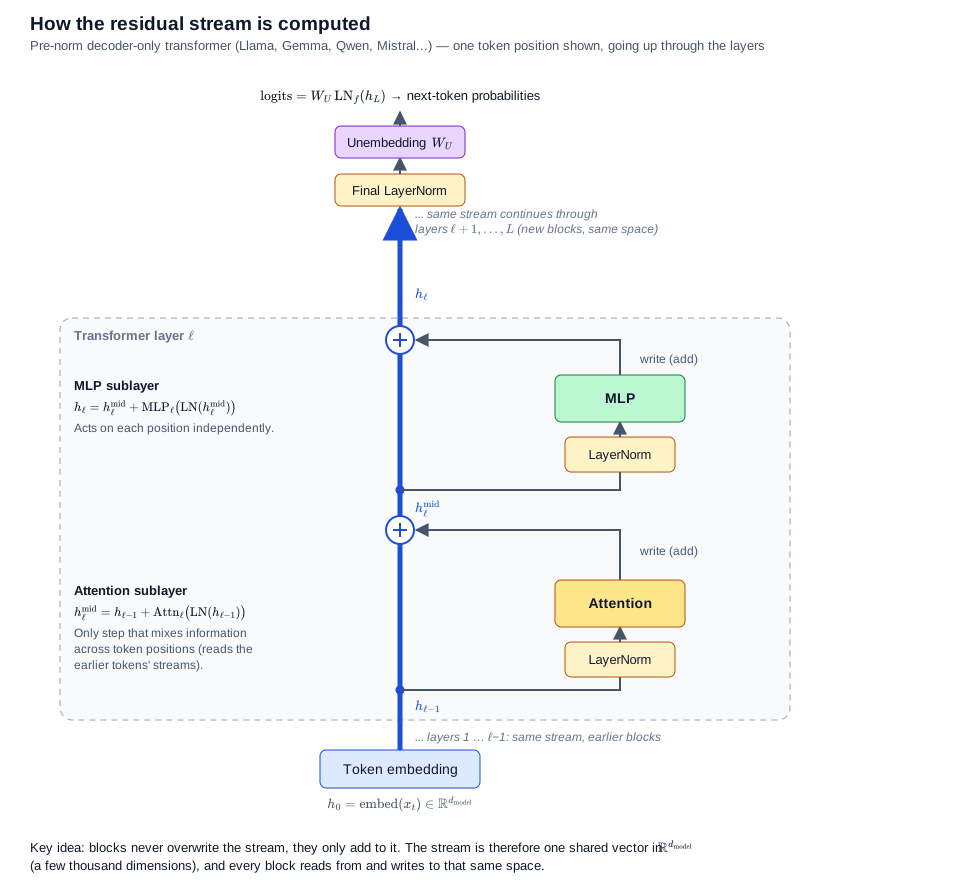
The residual stream is the running vector that a transformer carries from its input to its output. It starts as the embedding of the token, then every attention and MLP sublayer reads a (normalized) copy of it and adds its output back. Nothing is ever overwritten: the stream at layer is the token embedding plus the sum of everything written by the layers below.
Three things to keep in mind:
- One stream per token position. For a sequence of tokens, the activations at layer have shape
(T, d_model). Each token has its own stream vector, and attention is the only operation that lets a position read the streams of other positions. - It lives in , a few thousand dimensions (e.g. 4,096 for Llama 3.1 8B), not in the space of the billions of parameters. Its coordinate axes have no particular meaning: concepts are encoded as directions spread over many coordinates.
- It requires a pre-norm architecture to be a clean running sum: the Norm sits on the side branch, not on the main path (see Pre-norm vs post-norm decoder block).
Formula
Let be the stream entering layer , a normalization, the attention sublayer and the feed-forward sublayer:
Unrolling the recursion, with and the outputs of the attention and MLP of layer :
let’s break this formula step-by-step:
- is the embedding of the current token (the starting point of the sum).
- and are the contributions written by layer . The final stream is the sum of all of them, so each layer’s contribution can be read separately.
- is the final normalization applied once before the unembedding matrix (shape
(|V|, d_model), see Unembedding layer), which turns the stream into one score (logit) per vocabulary token.
What each component does to the stream:
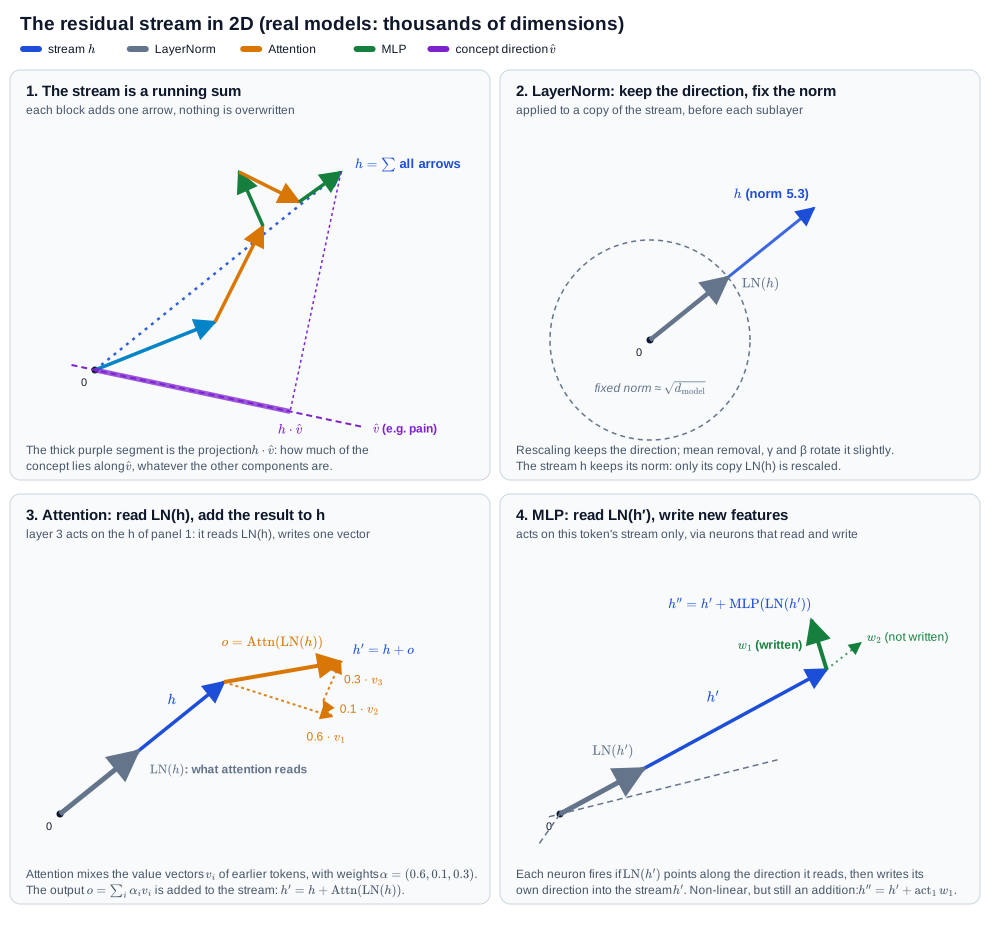
- LayerNorm (Layer Normalization) works on a copy of the stream before each sublayer. It subtracts the mean over the features and rescales to a fixed norm (), then applies a learned scale and shift . The rescaling itself keeps the direction and discards the magnitude, but the mean removal and the element-wise and rotate the vector slightly. RMSNorm, used by Llama, Qwen, Mistral and Gemma, has no mean removal (). The stream itself keeps its norm.
- Attention computes, for each head, a weighted average of vectors read from the streams of the current and earlier tokens: , with weights . The heads’ outputs are projected back to the stream by and added. It is the only step where information moves between positions.
- MLP acts on one position only: (note: modern models use a gated version). Each hidden neuron reads the stream along one direction (a row of ), fires depending on how aligned the stream is with it, and writes a fixed direction (a column of ) into the stream, scaled by its activation. It is non-linear, but its output is still just added.
Example
The figure below is a toy 2D version (, real models have thousands of dimensions, and the numbers are illustrative). It follows one stream through the four steps: the same is normalized, read by attention, then updated, and the result is read by the MLP.
Usage
- Reading a concept: since the stream is a sum in a single space, the projection at any layer measures how much of the concept direction is present. This is what difference-in-means probes do.
- Writing a concept (steering): adding to at one layer pushes the model along that direction, and the following layers read it as if a block had written it. Because the stream is never renormalized on its main path, the added vector is not rescaled in the stream itself. The sublayers still read a normalized copy, so its influence depends on its size relative to the stream norm (next point).
- Norm matters: in a pre-norm model the stream norm tends to grow with depth, so the same added vector weighs less in late layers.
- Reading the output: the final stream goes through to give logits, so applying to a direction shows which tokens it promotes or suppresses (the logit lens idea).
- Analyzing circuits: because the output is a sum of per-layer contributions, one can measure which attention heads or MLPs write the most along a given direction, which is the basis of the transformer-circuits line of work.